Should We Still Walk Past Every Victim
in Pursuit of the Active Killer?
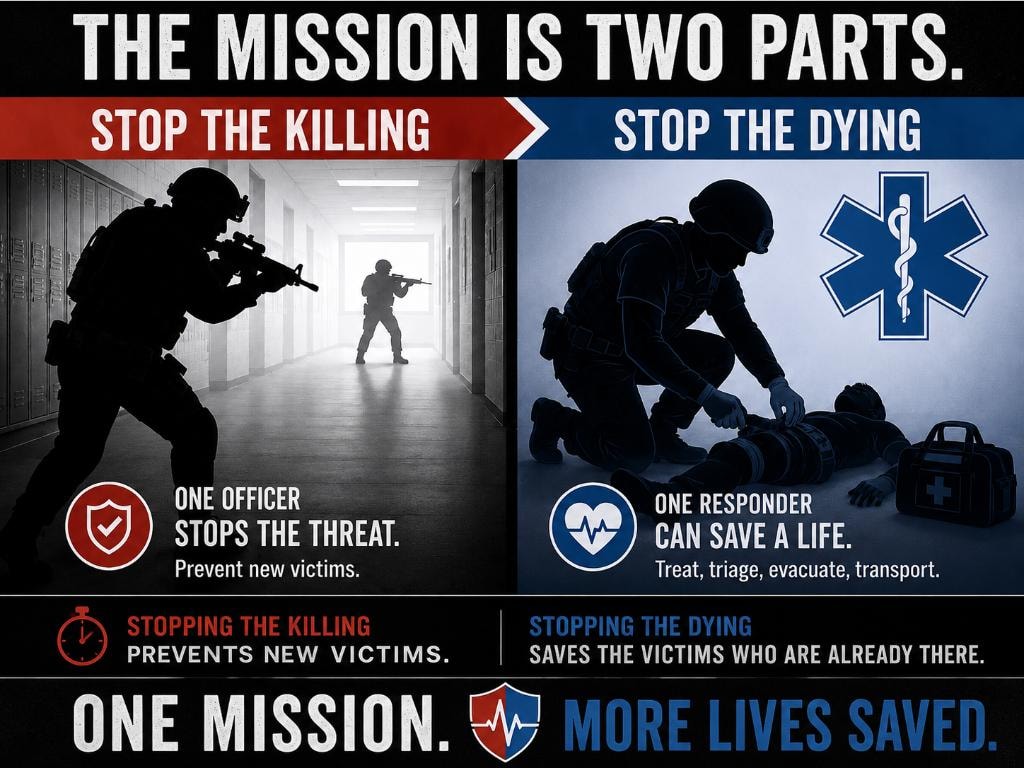
The doctrine for responding to an active killer has evolved dramatically over the past two decades. The mission is no longer simply "Stop the Killing." It is: Stop the Killing. Stop the Dying. These are not separate missions — they are sequential phases of the same mission.
Infographic
The Evolution of Doctrine
In the early years following incidents such as Columbine, the mission was clear: stop the killing. Officers were trained to move rapidly toward the threat, bypassing injured victims to neutralize the shooter as quickly as possible. Once the threat was stopped, law enforcement would systematically clear the remainder of the crisis site for additional suspects before medical care could begin. The priority was preventing new victims.
At that time, there was little emphasis on providing immediate medical care to casualties already lying injured.
Meanwhile, the wars in Iraq and Afghanistan transformed battlefield medicine. Military experience demonstrated that countless lives could be saved when simple, life-saving interventions — such as tourniquet application, hemorrhage control, and rapid casualty movement — were performed within minutes of injury. These lessons became the foundation of Tactical Combat Casualty Care (TCCC).
Recognizing that many of these principles applied equally to civilian active violence incidents, the Hartford Consensus adapted them into Tactical Emergency Casualty Care (TECC). The message was straightforward: preventing additional victims is only part of the mission. Saving the victims who have already been injured is equally important. Following additional lessons learned from incidents such as Uvalde, this philosophy has become the modern standard of care.
It Is Simply Math
Stop the Killing
- It takes one officer to stop an active killer.
- It may take many officers to search a large crisis site for additional suspects — depending on the size of the structure, available intelligence, and resources.
Stop the Dying
- It takes one responder to apply a tourniquet that may save a life.
- It takes many responders to treat, triage, evacuate, and transport multiple casualties to definitive care — the number required depends on the number of victims and available resources.
Every officer committed to an extended search is an officer unavailable to save a bleeding victim. That raises an important question: After the immediate threat has been neutralized, should every officer continue stepping over every victim while searching for a suspect who may not exist? This is not an argument against officer safety or thorough searches. It is an argument for dynamic decision-making.
The Answer Should Depend on the Situation
The response should be driven by the conditions on the ground — not by a rigid doctrine developed more than a decade ago.
We now know two things to be true:
Stopping the Killing prevents new victims.
Stopping the Dying saves the victims who are already there.
The Command Decision That Saves the Most Lives
Success is not measured solely by how quickly the shooter is stopped. It is also measured by how quickly wounded victims receive hemorrhage control, are evacuated, and reach an operating room.
The future of active killer response is not choosing between these two priorities — it is recognizing exactly when command must transition from "Stop the Killing" to "Stop the Dying." That decision, made at the right moment, may save more lives than any other command decision during the incident.