TACTICS
Phases of Command
Command doesn't start at the top — it starts inside, with the first officer, and transitions outward in deliberate phases.
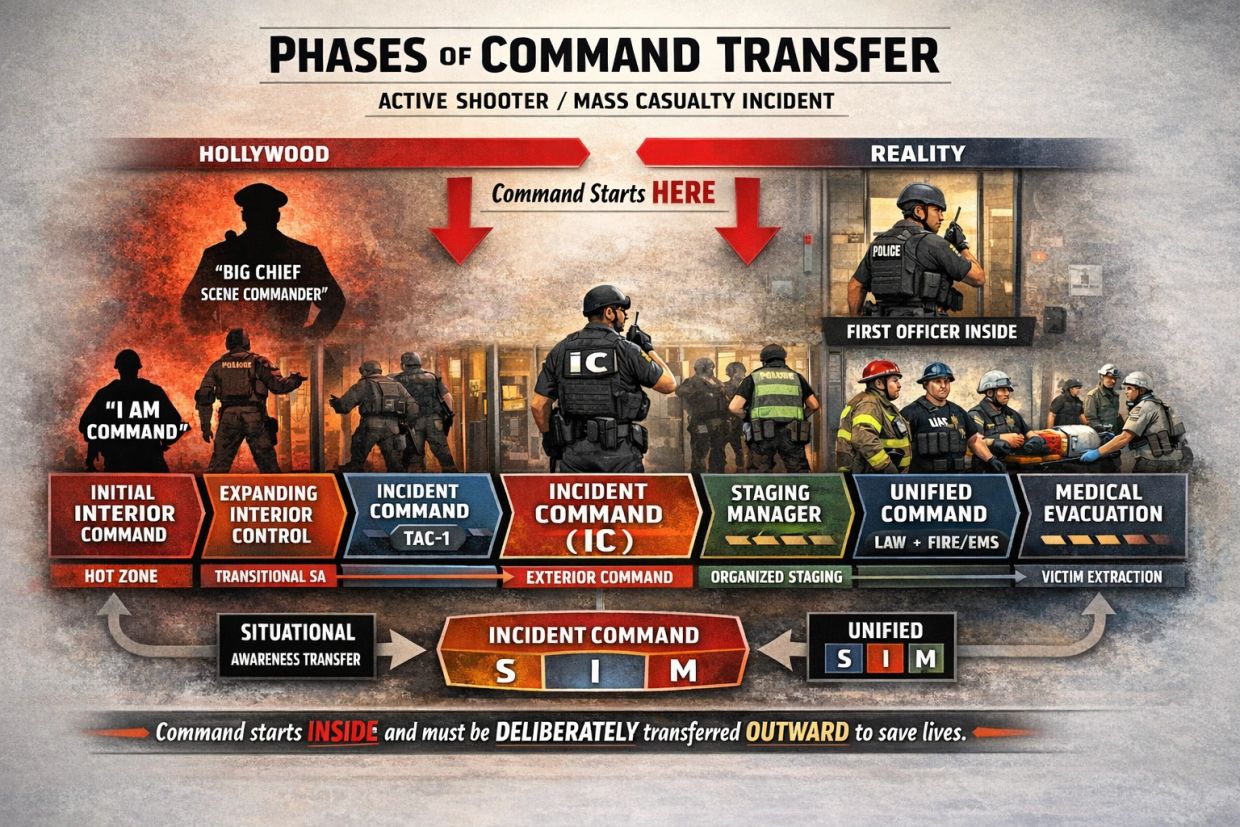
In an active shooter / mass casualty incident, command starts inside with the first officers and then transitions outward in phases. This is very different from Fire/EMS, where command is established from the exterior on arrival.
Initial Interior Command (Crisis Site)
Who: First arriving officer(s)
Where: Inside the hot zone / point of contact
- →Declare "I am Command"
- →Direct movement to stop the threat (Stop the Killing)
- →Assign immediate roles: contact team, rear security
- →Begin situational awareness of suspect, victims, environment
Often a solo officer acting as IC. Rank is irrelevant — initiative drives command.
Expanding Interior Command (Tac-1 Concept)
Who: First wave officers inside
Where: Still inside the crisis site
- →Transition from pure contact → control of the interior
- →Informally establish room boss / hall boss / floor boss
- →Communicate suspect status and victim locations
- →Begin thinking beyond shooting: "Where are my victims?"
Critical shift: Stop the Killing → Preparing to Stop the Dying.
Exterior Command Establishment
Who: First supervisor or designated officer outside
Where: Exterior, just outside the crisis site
- →Establish formal Incident Command (IC)
- →Identify and communicate with interior (Tac-1)
- →Begin perimeter control, resource tracking, staging location
Command is NOT taken blindly — it is received from interior awareness (Tac-1).
Command Transfer to Exterior (Staging Manager Role)
Who: Exterior IC / Staging Manager
Where: Just outside crisis site
- →Assume operational coordination from interior IC
- →Maintain linkage with Tac-1
- →Develop secure corridors and casualty evacuation pathways
- →Track incoming officers and RTF readiness
This is the MOST missed phase operationally. Prevents the "Blue Tsunami."
Unified Command (Law + Fire/EMS)
Who: Law Enforcement IC + Fire/EMS Command
Where: Established command post (Cold Zone)
- →Formal Unified Command
- →Align priorities: Security (LE) + Medical (Fire/EMS)
- →Deploy Rescue Task Forces (RTFs)
- →Establish Ambulance Transfer Point (ATP)
Framework: S – Security | I – Incident Command | M – Medical + Movement.
Operational Control & Medical Evacuation
Who: Unified Command with Ops / Med branches
Where: Command post
- →Coordinate RTF entry into warm zone
- →Coordinate evacuation flow
- →Maintain secure corridors and force protection
- →Prioritize rapid movement to definitive care
End State Goal: Victims to higher level of care ≤ 30 minutes.
"Command starts inside the gunfight and must be deliberately transferred outward to save lives."