TACTICS
Why AS/MC Response Fails
Stop the Killing → Stop the Dying. A phase-by-phase breakdown of active shooter response and the failure points that cost lives.
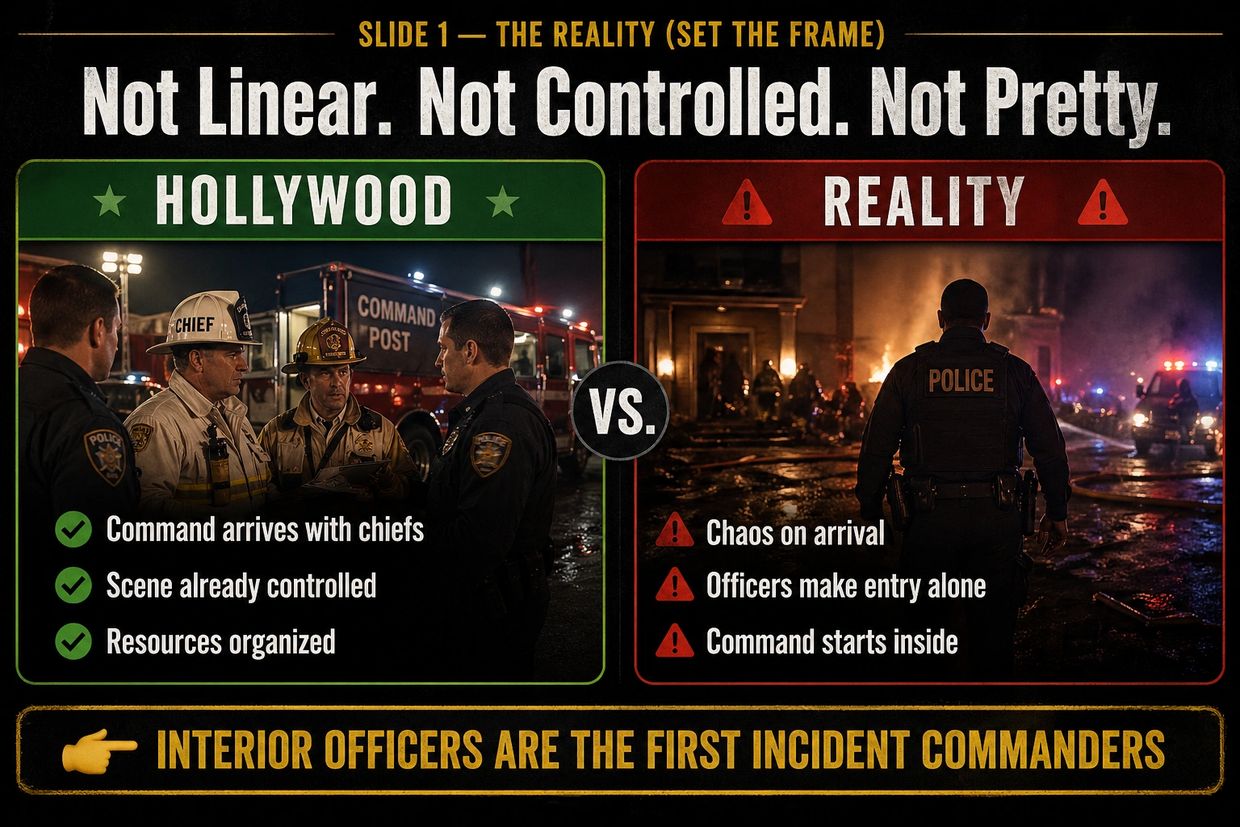
Hollywood
Command arrives with chiefs. Scene already controlled. Resources organized.
Reality
Chaos on arrival. Officers make entry alone. Command starts inside.
Initial Entry (Stop the Killing)
First officer makes entry, moves toward threat, assumes Interior Command. No staging, no delay.
Contact Team Formation
Additional officers link up en route. Form ad hoc contact team. Movement continues toward threat. No waiting for full team.
Contact & Neutralization
Suspect located, immediate engagement, threat neutralized or contained. Rapid assessment for additional threats.
Transition Point
The most critical moment. If threat ongoing: continue pursuit, limited aid only. If threat stopped: shift to Stop the Dying, call for Fire/EMS, begin coordination.
Exterior Command / Staging
Supervisor establishes Exterior Command, designates Tac-1 (Interior Lead), creates Staging Area, stops freelancing.
Prevent the Blue Tsunami
Without control: officers stack inside, no coordination, victims bypassed. With staging: controlled deployment, assigned roles, organized flow.
Secure Corridor
Identified by Tac-1, secured by LE, connects hot/warm → cold zone, enables movement of RTF + victims. No corridor = no evacuation.
RTF Deployment
Fire/EMS integrates with LE. RTF = Care + Protection. Enter via secure corridor. Treat + move simultaneously.
Unified Command
LE + Fire establish Unified Command. Shared situational awareness, coordinated priorities, resource allocation.
CCP → ATP Flow
Crisis Site → Secure Corridor → CCP → ATP → Hospital. Rapid removal over perfect care. Continuous movement. Stabilize → Move → Save.
"Stop the Killing → Stop the Dying is a COMMAND problem first."