TACTICS
Vision Drives OODA Loop
Central vs. peripheral vision in the OODA Loop — why officers often lose the draw, and how to train for it.
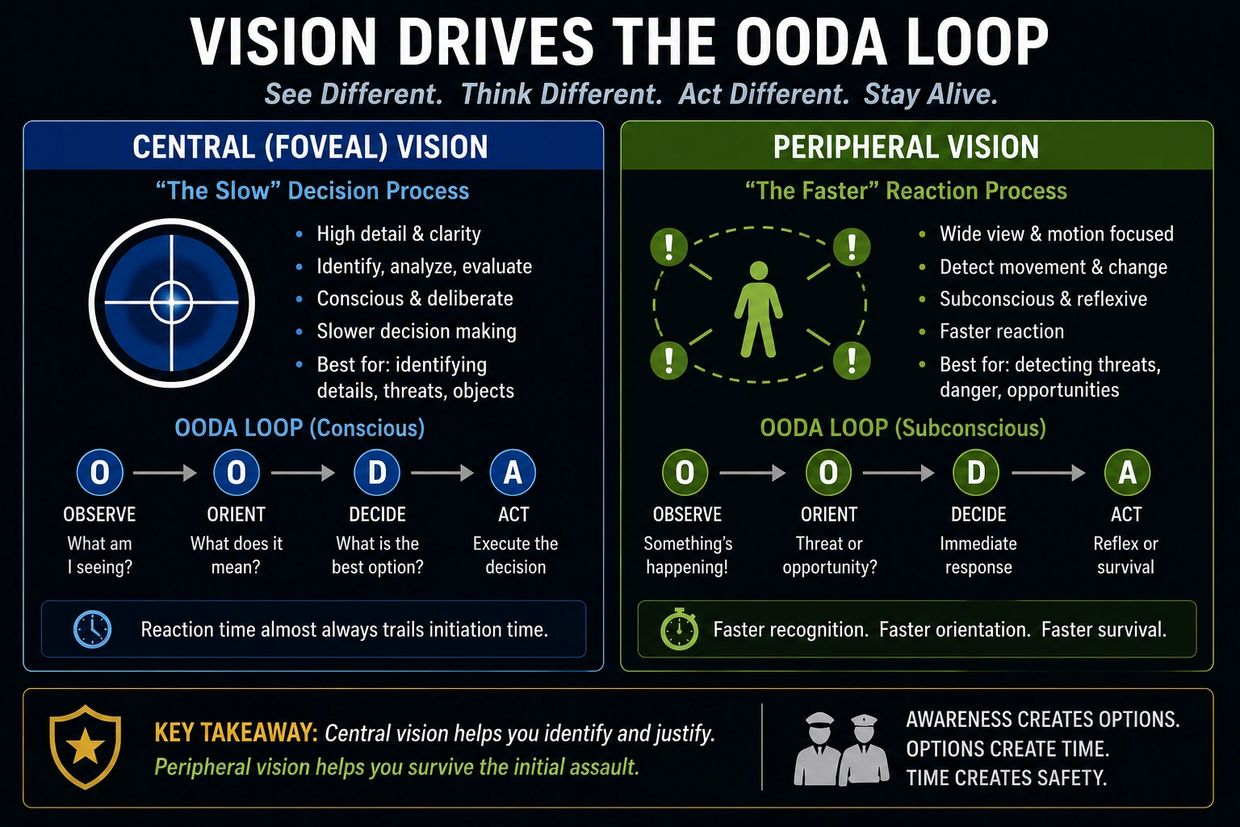
The brain does not process all visual information equally. There is a major operational difference between Foveal/Central Vision and Peripheral Vision — and both influence how officers perceive threats and how quickly they react.
Foveal (Central) Vision
Precision Vision = Slower Processing
Used for reading, identifying faces, seeing weapon details, aiming sights. Initiates the conscious OODA Loop: Observe → Orient → Decide → Act.
Analytical, conscious, deliberate — but also slower, reactive, and vulnerable to hesitation under stress.
Peripheral Vision
Survival Vision = Faster Reaction
Motion-sensitive, threat-oriented, reflexive, faster. Bypasses much of the conscious analytical process. The brain reacts: "Something dangerous is happening NOW."
Faster body movement, faster defensive reactions, faster evasive movement — often before conscious thought fully catches up.
Why Suspects Often Appear "Faster"
Officers frequently describe: "I never saw the gun until it was already out." Part of this is because the suspect is often acting proactively, initiating movement, operating from intention — while the officer is observing, identifying, legally evaluating, and reacting.
Reaction time almost always trails initiation time.
Tactical Implications
- →Movement helps reset the threat cycle — getting off the "X" forces the suspect to reorient and disrupts their OODA Loop
- →Threat recognition must be pattern-based — experienced officers react before conscious identification is complete
- →Train peripheral awareness — many qualifications unintentionally overtrain static focus and front-sight fixation
Central vision helps officers identify and legally justify force. Peripheral vision helps officers survive the initial assault.