COMMAND
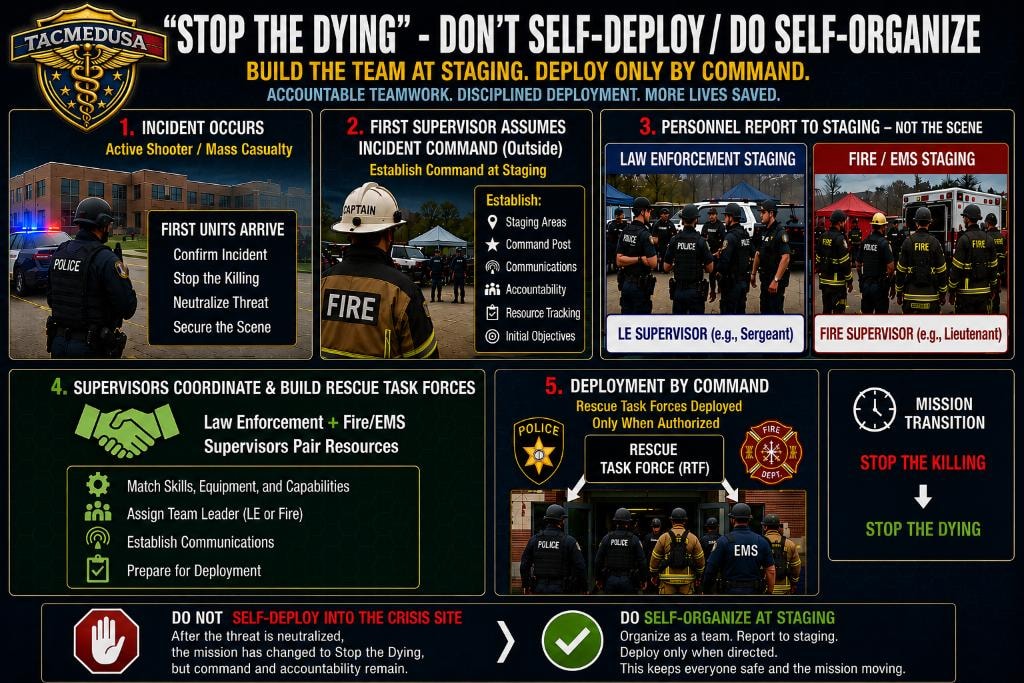
"Stop the Dying"
Don't Self-Deploy / Do Self-Organize
Build the team at staging. Deploy only by command. Accountable teamwork, disciplined deployment — more lives saved.
One question frequently asked during Active Shooter/Mass Casualty Incident training is whether a Fire Captain or Police Command Officer must be present before Rescue Task Forces (RTFs) can be formed. I would argue no because "Minutes Matter". Every minute spent waiting to organize personnel may delay hemorrhage control, airway management, casualty evacuation, and ultimately definitive surgical care.
In an active shooter response, speed saves lives—but uncontrolled self-deployment can cost lives. The fastest response is one that combines rapid deployment with disciplined command and control. That balance is what allows responders to transition effectively from "Stop the Killing" to "Stop the Dying."
After the active threat in an Active Shooter/Mass Casualty Incident has been neutralized, no law enforcement officer or Fire/EMS provider should self-deploy into the crisis site. The mission has changed from "Stop the Killing" to "Stop the Dying," but accountability and command remain essential. However, this does not mean responding patrol officers should simply stand idle waiting for assignments. An often quoted statement is "Look For Work".
The key distinction is this:
As additional officers arrive and the immediate tactical mission has stabilized, they should:
This approach provides several advantages:
One of the biggest misconceptions during an Active Shooter/Mass Casualty Incident is that a Rescue Task Force (RTF) can be formed simply because a few police officers and Fire/EMS personnel happen to be standing together.
The answer is no. A Rescue Task Force is not simply a group of people. It is an operational resource that functions within the Incident Command System (ICS). It must be assigned a mission, operate under command, maintain accountability, and communicate with the rest of the incident.
Along with the Rescue Task Force model is the Law Enforcement Rescue Model. Officers inside the crisis site who do not have a tactical role inside the crisis site such as creating a secure corridor or secure island should not sit around idle. The Law Enforcement Rescue model works concurrently with the Rescue Task Force Model. As minutes matters, officers can treat, triage and transport victims to their level of skill and medical supplies that they have brought with them into the crisis site.
Who Creates a Rescue Task Force?
A Rescue Task Force should be created by the incident command structure—not by individual responders.
Depending on the size and complexity of the incident, this may involve:
The important principle is not whether someone is wearing "stars and bars" or a captain's bugles. The important principle is that someone with operational authority has assigned that team a mission within the ICS structure.
Why Self-Deployment Is Dangerous
Imagine four police officers standing at the law enforcement staging area. They walk over to four firefighters and say:
"We're available. Let's go."
That is not an RTF.
Immediately several critical questions arise:
Without command and accountability, responders can easily become part of the problem rather than the solution.
Rescue Task Forces Must Be Managed
Each RTF should have:
This allows Incident Command to know exactly:
Staging Exists for a Reason
The staging area is much more than a parking lot.
It is where resources are:
If responders simply leave staging on their own initiative, Incident Command loses accountability and situational awareness. This increases the risk of:
Flexibility Within Command
This does not mean the process has to be slow or bureaucratic.
A well-trained Unified Command can build and deploy RTFs in seconds.
The difference is that deployment is intentional, communicated, and tracked, rather than improvised by individual responders.
The Bottom Line
Rescue Task Forces are not created by responders shaking hands in the staging area.
They are created through Incident Command.
Every RTF should have:
"In an active shooter response, speed saves lives—but uncontrolled self-deployment can cost lives. The fastest response is one that combines rapid deployment with disciplined command and control."