TACTICS
STK & STD Gap
The hybrid response model: eliminating the gap between Stop the Killing and Stop the Dying through shared responsibility.
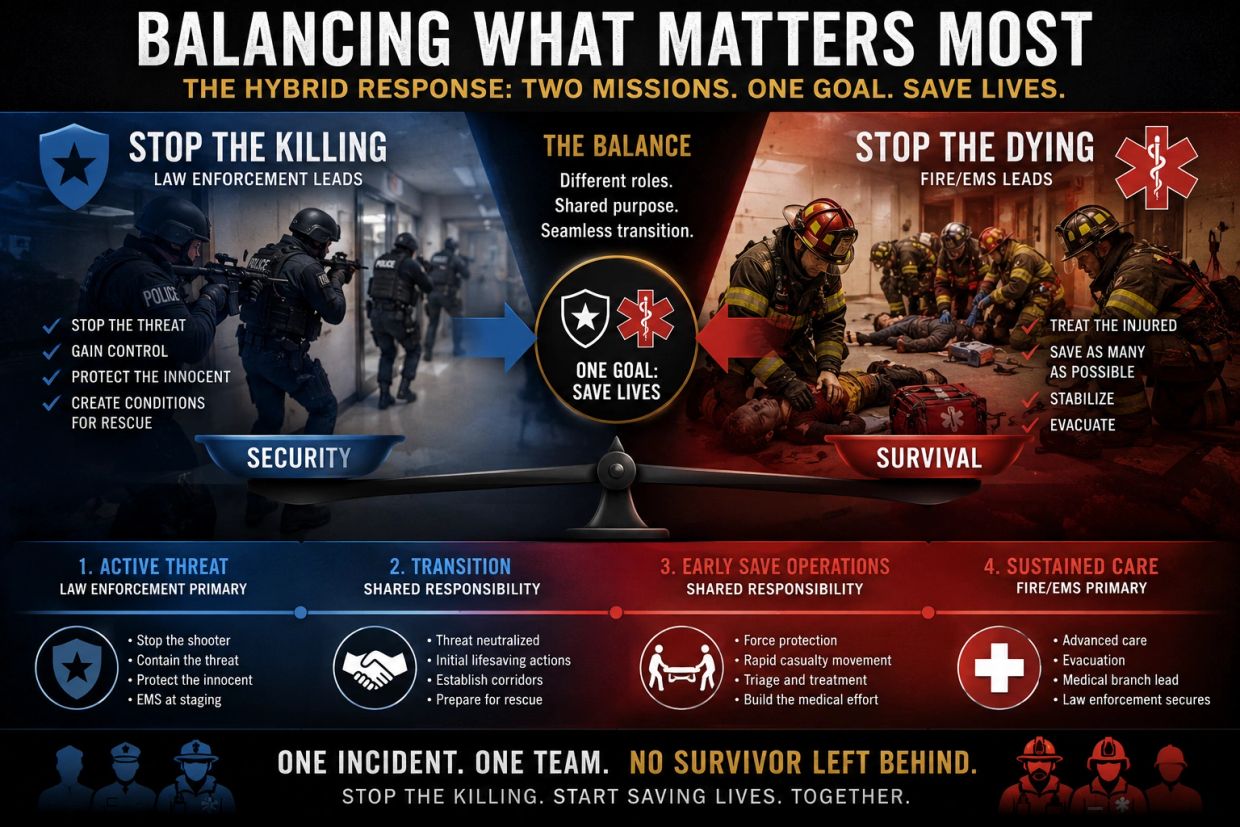
In the hybrid response model, the goal is to eliminate the gap between "Stop the Killing" and "Stop the Dying." This is not the Law Enforcement Rescue Model (where police do most of the casualty care) nor the Traditional RTF Model (where Fire/EMS performs nearly all patient care). Instead, it asks: "Who can reach the victim first, and what is the fastest intervention that can keep that victim alive until higher-level care arrives?"
Phase 1: Active Threat
Law Enforcement
Contact teams move to stop the shooter. Additional officers establish containment and force protection. Fire/EMS remains at staging. Priority: Stop the Killing.
Phase 2: Threat Neutralized, Scene Not Fully Controlled
Shared Responsibility Begins
LE officers who completed the contact team mission may apply tourniquets, perform casualty drags, establish CCPs, and create secure corridors. Simultaneously, RTFs prepare for deployment and Medical Branch begins planning.
Phase 3: Early Stop the Dying Operations
Balanced Shared Responsibility
LE provides force protection, maintains secure corridors, escorts medical teams, and controls movement. Fire/EMS assumes primary medical care: triage, airway management, hemorrhage control, packaging and transport.
Phase 4: Sustained Medical Operations
Primary: Fire/EMS
Once threat is neutralized, corridors established, and force protection in place — Fire/EMS becomes the lead agency for patient care. LE continues security, investigations, and scene control.
Stopping the Killing ends the threat. Stopping the Dying begins immediately — not when Fire/EMS arrives. Law enforcement bridges the survival gap.