MEDICAL
Small Hole and Big Bleed
Junctional injuries may have small entrance wounds but large underlying wound cavities. You are not packing the hole — you are packing the bleed.
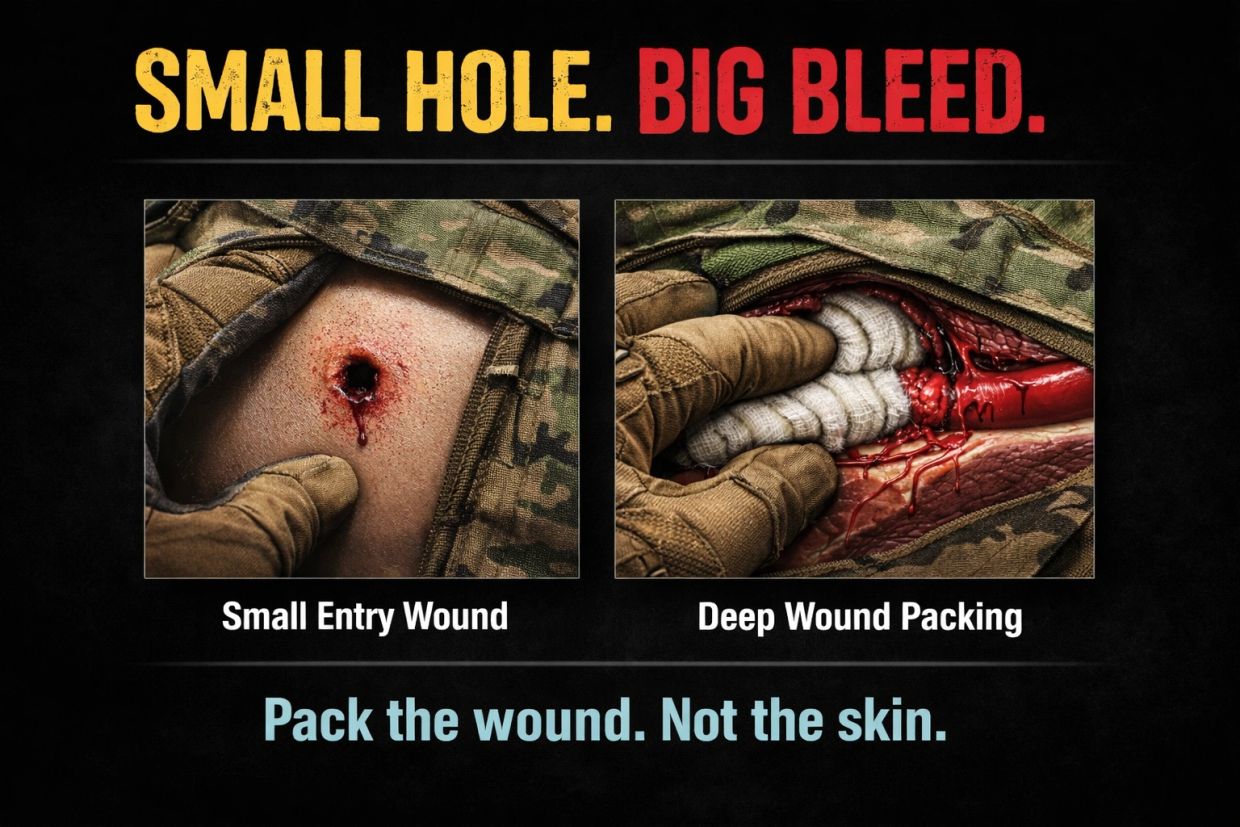
Gunshot wounds to the groin or axilla are not amenable to a tourniquet since the injury is above the extremity. What makes these junctional injuries even more lethal is that the diameter of the vessel is very large. The conventional wisdom is to wound pack these injuries. However, the entrance site from a 9mm or 5.56 might be small while the underlying wound cavity that needs to be filled is large.
Typical Entrance Wound Size
Most entrance wounds are approximately 0.5× to 1.5× the bullet diameter:
- →9mm round (~9mm / 0.35 in): entrance wound often 5–12mm (≈0.2–0.5 inches)
- →Skin is elastic — it stretches and recoils, so the wound can appear smaller than the bullet
- →Higher velocity → more tissue disruption → potentially larger/irregular wound
Critical Teaching Point
You are not packing the "hole" — you are packing the BLEED.
Many GSW entrance wounds are small, narrow tract, and not easily packable. Common mistakes include:
- →Packing only the surface
- →Not going deep enough
- →Stopping when resistance is felt too early
- →Not holding pressure long enough
"If it's bleeding and you can get a finger in it — you can pack it." Don't be fooled by a small entrance wound.