TRAINING
The Scenario Isn't Over Until the Last Victim Reaches the Ambulance Transfer Point
Training scenarios that end when the shooter is neutralized train only half the mission.
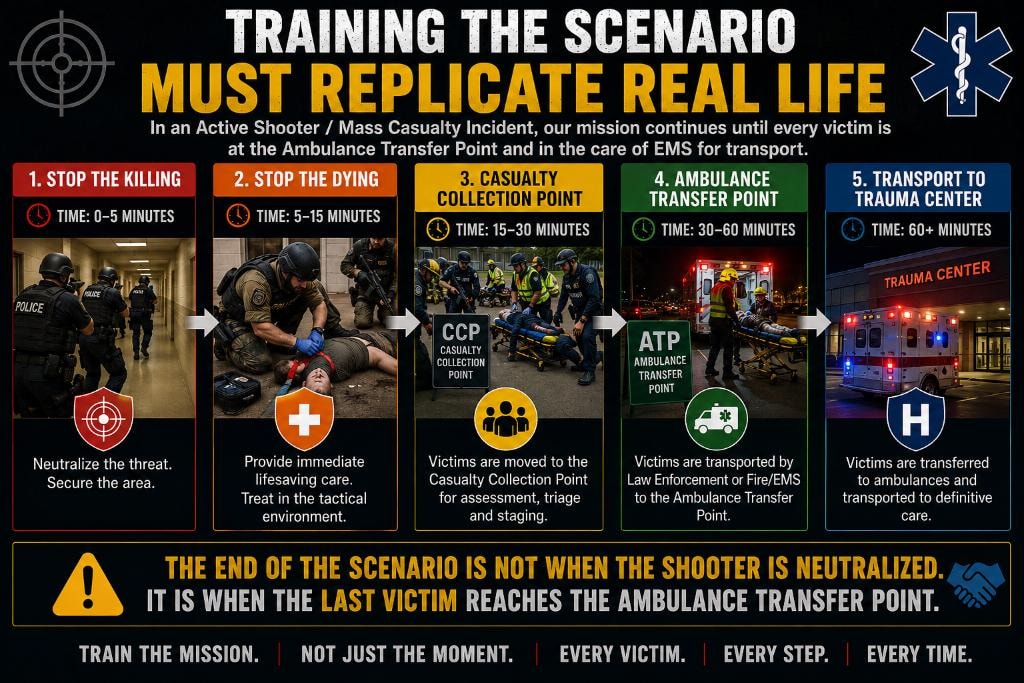
One of the most common shortcomings in active shooter/mass casualty incident training is ending the scenario the moment the suspect is neutralized.
In reality, that is only the end of the "Stop the Killing" phase. The mission is not complete until "Stop the Dying" has also been accomplished. The true measure of success is not simply how quickly the threat was stopped, but how efficiently casualties were treated, moved, and delivered to the Ambulance Transfer Point (ATP) for transport to definitive care.
The Five Phases of the Mission
Stop the Killing
0–5 Minutes
Neutralize the threat. Secure the area.
Stop the Dying
5–15 Minutes
Provide immediate lifesaving care. Treat in the tactical environment.
Casualty Collection Point
15–30 Minutes
Victims are moved to the CCP for assessment, triage, and staging.
Ambulance Transfer Point
30–60 Minutes
Victims are transported by Law Enforcement or Fire/EMS to the ATP.
Transport to Trauma Center
60+ Minutes
Victims are transferred to ambulances and transported to definitive care.
Training Scenarios Should Continue Until Every Viable Victim Has:
- →Received immediate lifesaving interventions appropriate to the tactical environment.
- →Been moved from the point of injury through secure evacuation corridors.
- →Reached the Casualty Collection Point (CCP), when used.
- →Been transported by law enforcement or Fire/EMS to the Ambulance Transfer Point.
- →Been transferred to waiting ambulances for rapid transport to trauma centers.
This final phase requires disciplined command and control, coordinated movement, casualty accountability, secure evacuation corridors, and seamless integration between law enforcement and Fire/EMS.
In an actual incident, the mission does not end because the threat has been neutralized. The clock is still ticking for the wounded. Officers and Fire/EMS must continue to communicate, adapt to changing conditions, solve logistical problems, and move casualties under realistic time pressures until every victim reaches the Ambulance Transfer Point. If these challenges are not practiced during training, they are unlikely to be performed efficiently during a real event.
Training Should Evaluate the Entire Response
Success should be measured by more than suspect neutralization. It should include:
- →How quickly command transitioned from Stop the Killing to Stop the Dying.
- →How effectively law enforcement and Fire/EMS integrated their operations.
- →How efficiently casualties were evacuated.
- →Whether every victim reached the Ambulance Transfer Point as rapidly and safely as possible.
The End of the Scenario Is Not When the Shooter Is Neutralized
It is when the last victim reaches the Ambulance Transfer Point and is in the care of EMS for transport to definitive medical care.
Stopping the shooter saves future victims. Getting the wounded to the Ambulance Transfer Point saves the victims who are already injured.
If a scenario ends when the shooting stops, participants train for only half of the mission.
Train the mission — not just the moment.
Every victim. Every step. Every time.