TACTICS
Open-Air Gunfights
Don't Get Into an Open-Air Gunfight — Inside or Outside, Everyone Loses

One of the most important lessons from modern law enforcement gunfights is that officers are often shot by suspects they cannot even see.
Many officers still envision a gunfight as two people standing in the same room exchanging fire. The reality is very different.
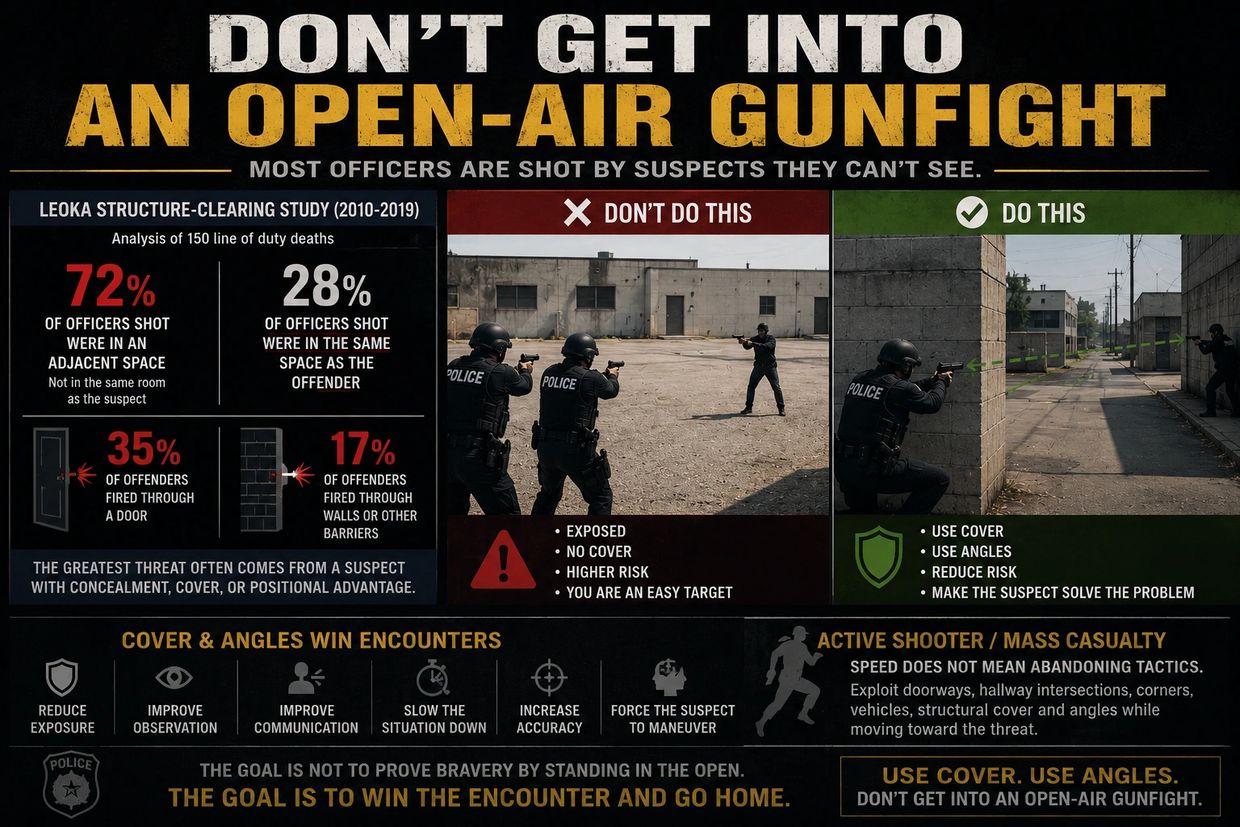
Analysis of FBI LEOKA officer deaths during structure-clearing incidents found:
These statistics demonstrate that the greatest threat often comes from a suspect who has concealment, cover, or positional advantage while the officer is exposed.
Open-Air Gunfights Favor the Suspect
When officers step into the open and engage an armed suspect without cover, they surrender many of the advantages available to them.
The encounter becomes a contest of:
Even highly trained officers experience degraded performance under stress. The officer standing in the open presents a full target while receiving little protection from incoming rounds.
Cover Is a Force Multiplier
Cover changes the engagement.
A building corner, concrete wall, engine block, pillar, or other ballistic barrier allows officers to:
Instead of solving the suspect's tactical problem, officers make the suspect solve theirs.
Angles Win Fights
Corners create tactical advantages.
An officer using angles can often:
The officer who understands angles is often fighting from a position of advantage before the first shot is fired.
Active Shooter Exception
During an Active Shooter / Mass Casualty Incident, officers may have to accept greater risk to rapidly stop ongoing killing.
However, even during a rapid deployment:
Speed does not mean abandoning tactics.
Officers should continuously exploit:
while moving toward the threat.
The Real Lesson
The LEOKA data demonstrates that officers are frequently shot by suspects in adjacent spaces, through doors, and through walls—not during a traditional face-to-face gunfight.
The goal is not to prove bravery by standing in the open.
The goal is to win the encounter while minimizing risk to officers, innocent people, and fellow responders.
Use cover. Use angles. Don't get into an open-air gunfight if you don't have to.
Winning the Gunfight Is More Important Than Being in the Gunfight
One of the most common training scars in law enforcement and tactical training is the tendency to move into an open-air gunfight with an armed suspect when cover, concealment, or positional advantage is available.
The objective is not to exchange gunfire.
The objective is to stop the threat while minimizing risk to officers, bystanders, and innocent victims.
Open-Air Gunfights Favor Luck
When officers engage a suspect in an open area without utilizing available cover, the outcome often becomes a contest of:
Even highly trained shooters experience a significant degradation in accuracy during lethal force encounters. Heart rate, stress, movement, poor lighting, and rapidly changing circumstances all reduce performance.
The result is often:
Cover Changes the Equation
Cover is a force multiplier.
A concrete wall, engine block, building corner, large pillar, or substantial barrier provides protection while allowing officers to:
Cover allows officers to dictate the engagement rather than react to it.
The suspect may have a weapon, but cover can significantly reduce their ability to effectively use it.
Angles Win Gunfights
Corners, hallways, doorways, and building edges create angles that can be exploited.
By using angles, officers can:
A suspect standing in the open may be visible to multiple officers positioned at different angles, while only having an effective line of sight on one officer at a time.
The officer who uses angles intelligently often gains a tremendous advantage before the first shot is fired.
The Active Shooter Exception
During an active shooter incident, officers may be required to accept significantly greater risk to immediately stop ongoing killing.
However, even during an active shooter response, officers should not unnecessarily abandon available cover and angles.
The mission is still:
Stop the Killing.
But that does not mean:
Expose yourself unnecessarily.
Officers should continually exploit terrain, structures, hallways, door frames, vehicles, and corners whenever available while moving toward the threat.
The Tactical Mindset
A useful question for officers to ask is:
"Do I have to be standing here?"
If the answer is no, then there may be a better position available.
The best position is often one that:
The officer who can see the suspect while exposing the least amount of themselves has a significant advantage.
Final Thought
Gunfights are not won by standing in the open and exchanging rounds.
They are won by using tactics, positioning, communication, cover, angles, and sound decision-making.
The goal is not to prove courage by exposing yourself to danger.
The goal is to go home at the end of the shift while ensuring innocent people do as well.