TACTICS
Drags & Carries vs. Quick Litter Evacuation
When every second counts, the right equipment makes all the difference.
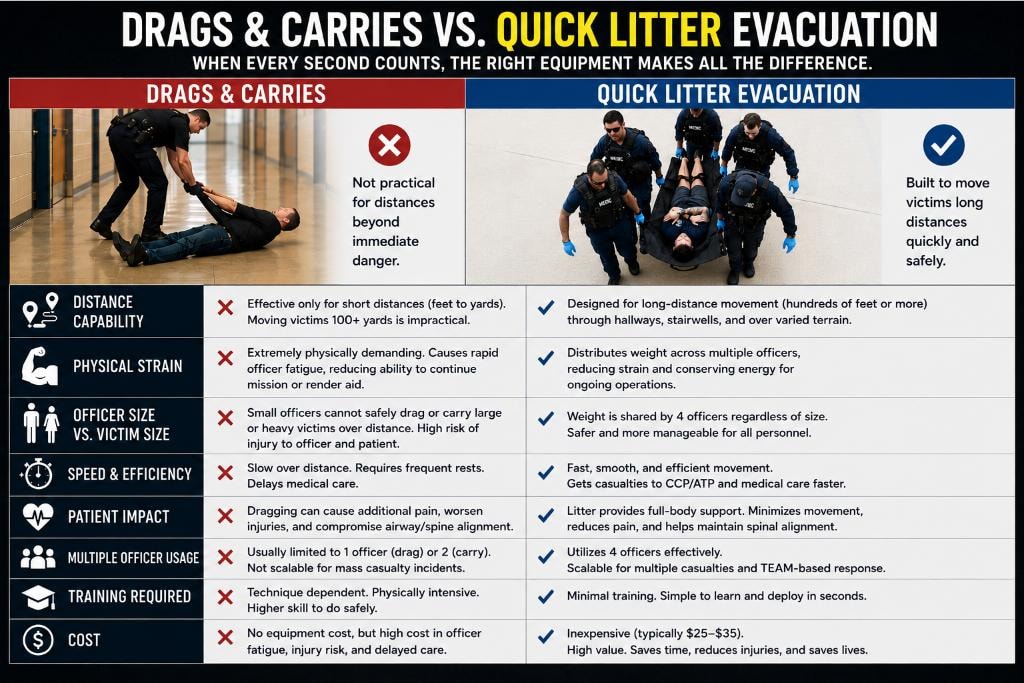
Why Drags and Carries Are Not Enough
For decades, law enforcement officers have been taught victim drags and carries as part of active shooter response. These techniques absolutely have a role — but that role is limited. They are appropriate for moving a victim a short distance out of immediate danger when no better option exists. They should not be considered the primary method of evacuating casualties from the crisis site to a Casualty Collection Point (CCP) or Ambulance Transfer Point (ATP).
In a real active shooter or mass casualty incident, victims often must be moved hundreds of feet through hallways, classrooms, office buildings, stairwells, parking structures, or around obstacles before reaching Fire/EMS personnel or transport resources. Moving an adult over these distances by drag or carry is slow, physically demanding, and rapidly exhausts officers who may still be responsible for security, command and control, or searching for additional threats.
The problem becomes even more significant when the victim outweighs the officer. Adult victims may be unconscious, obese, injured, or covered in blood, making them difficult to grip and move. Officers are simultaneously wearing body armor, helmets, duty belts, and carrying rifles while navigating narrow hallways, debris, furniture, locked doors, and chaotic environments. This is not a question of determination or training — it is simply a matter of physics.
Operational Consequences
Manpower Collapse
Every officer dragging a casualty is no longer providing security, clearing rooms, or protecting RTF personnel. With numerous victims, one or two officers per patient rapidly depletes available force.
Compromised Security
Officers dragging casualties lose optimal weapon control, reduce situational awareness, and become task-fixated on a single patient — at the exact moment security remains essential.
Worsened Injuries
Improvised drags can disrupt clot formation, dislodge tourniquets, increase hemorrhage, or aggravate unstable pelvic or spinal injuries.
The Blue Tsunami
Officers naturally converge on injured victims. Multiple responders attempt inefficient carries, hallways congest, and heroic individual effort replaces organized evacuation — slowing movement for every patient.
The Solution Already Exists
Commercial quick litters and other compact evacuation devices are lightweight, inexpensive, durable, and require minimal training. Costing approximately $25–35 each, they distribute a patient's weight among multiple rescuers, allowing four officers to carry a casualty feet first over long distances with far less physical strain than traditional drags or carries. They improve movement through hallways, stairwells, and around obstacles while reducing responder fatigue and allowing personnel to return to their operational responsibilities more quickly.
These devices also integrate naturally into the Rescue Task Force (RTF) model. Law enforcement provides force protection, secures evacuation corridors, and maintains command and control, while Fire/EMS delivers advanced medical care, triage, and transport. This system emphasizes coordinated throughput rather than isolated acts of heroism and maximizes survival for the greatest number of patients.
Every Active Shooter Response Kit Should Include
- →A commercial quick litter or other compact evacuation device.
- →Tourniquets and hemorrhage-control equipment.
- →Basic casualty movement training using the litter.
- →Integration of casualty evacuation procedures with Rescue Task Force operations.
The goal is not simply to remove victims from danger — it is to move them rapidly, safely, and efficiently to definitive medical care.
As active shooter doctrine continues to evolve, casualty evacuation must evolve with it. Drags and carries should remain emergency techniques of last resort — not the primary transport strategy. The future of active shooter response depends on systems rather than heroics. Organized casualty movement, secure evacuation corridors, Rescue Task Force integration, and inexpensive evacuation litters provide a scalable solution for mass casualty incidents.